

This is NSS – more about us
Archipelago Cooperation – vibrant connections across our shared sea
The Nordic Archipelago Cooperation is a cross-border governmental collaboration covering the archipelago regions in Stockholm, Uppsala, Södermanland, and Östergötland counties, the regions of Southwest Finland, Uusimaa, and Kymenlaakso, as well as Åland. The coastal area stretches 800 km as the crow flies, and about 50,000 people live in the archipelago year-round. We hope this number will increase in the future.
The organization works to increase cooperation between regions and countries within its area of operation and to maintain connections between coastal and archipelago areas. In addition, NSS organizes seminars and inspirational forums to highlight development needs or opportunities that both authorities and the private sector can pursue. Our focus is on contributing to greater knowledge about conditions in our archipelagos and coastal areas. We achieve this in various ways through active cross-sector engagement and by participating in the working groups of our cooperation partners.
Organization
The main authorities of the Archipelago Cooperation are the County Administrative Board of Stockholm, Region Stockholm, the Stockholm Archipelago Foundation, the County Administrative Board of Uppsala, Region Södermanland, Region Östergötland, the Åland archipelago municipalities of Brändö, Föglö, Kumlinge, Kökar, Sottunga, and Vårdö, the Southwest Finland Council and the Southwest Finland ELY Centre, as well as the Uusimaa Council and the Uusimaa ELY (Centre for Economic Development, Transport and the Environment).
Statutes
In 2018, new statutes were drafted and approved at the Council Meeting in 2019. The highest decision-making body of the Archipelago Cooperation is the Cooperation Council, whose decisions are implemented by the Cooperation Board and the Cooperation Director.
Download our statutes NSS_stadgar_2019 (pdf)
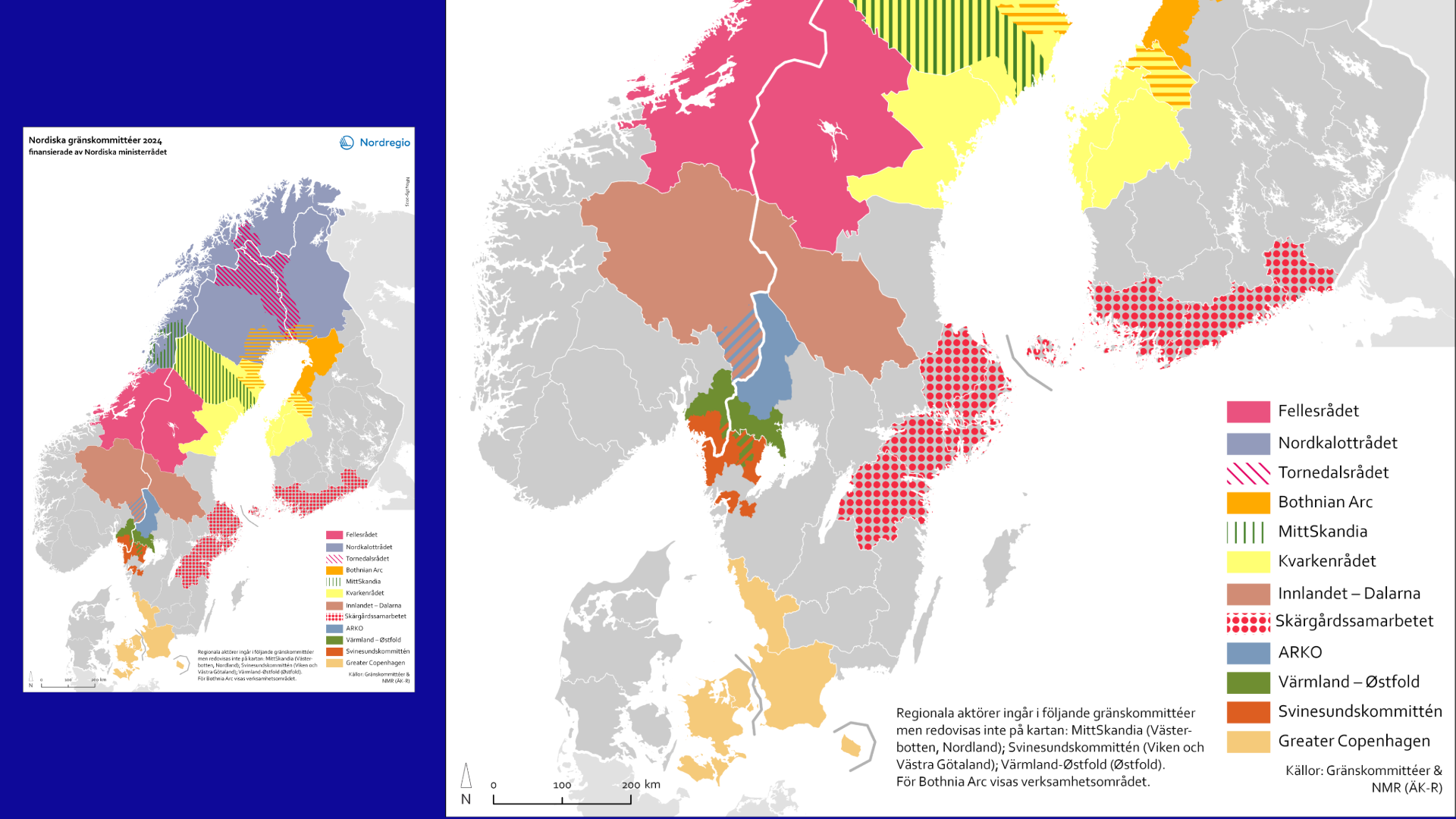
Map of all border committees
Below you can find Nordregio’s map of all cooperating committees in the Nordic region.
NSS is a border committee – what does that mean?
The Nordic region has a unique cross-border cooperation. Border committees are the platforms that practically develop our areas in line with the Nordic strategic vision: the Nordic region as the world’s most sustainable and integrated region by 2030. The Nordic region has 30 million inhabitants and the world’s 11th largest economy.
Cross-border cooperation in the Nordic region consists of 13 cross-border committees working in the border areas between Denmark, Sweden, Finland, and Norway.
The border committees primarily work to promote the competitiveness of businesses in the border regions, identify and remove border obstacles, develop sustainable and climate-friendly environmental and energy solutions, improve infrastructure and communications relevant to the border areas, and manage land use in these regions.
Contact for gränskommittérna
Nordic Council of Ministers
The Nordic Council of Ministers, founded in 1971, is the collaborative body for the governments of the Nordic countries and the self-governing territories. In the Council of Ministers, representatives of the national governments address matters that have been agreed upon jointly.
The Council of Ministers follows the recommendations of the Nordic Council and reports to the Council on current political issues affecting the Nordic region. The Council of Ministers also initiates its own proposals. Overall responsibility for the Council of Ministers’ activities lies with the prime ministers of the five Nordic countries. In practice, the work is led by the Nordic Cooperation Ministers and the Nordic Cooperation Committee.
The new Secretary General in 2023 is Karen Ellemann; “now it is important that we join forces, identify where we can improve, and in this way strengthen Nordic cooperation.”
Get to know the NCM här.
Nordic Council
The Nordic Council, founded in 1952, is the forum for cooperation between parliamentarians and ministers.
The Nordic Council is unique in the world, as it is the only forum where parliamentarians from one country can question ministers from other countries and engage in political discussions with the governments of neighboring countries.
The Nordic Council has no formal power as an institution, but each government has the authority to implement the Council’s decisions into its national legislation with parliamentary approval.
The priorities are on the Secretary General’s desk in cooperation with the Nordic Council.